absolutely brilliant day (despite a landslide trying it’s best to outwit us!) in london town on a college trip. went to royal academy show “sensing spaces:reimagining architecture” – couldn’t have been a more perfect exhibition to go and see for what i’m currently looking at.
show blurb “Visitors to Sensing Spaces: Architecture Reimagined will experience a new type of architecture exhibition. Described as an approach that highlights not the functional but the experiential aspects of architecture, it features the work of seven of the world’s leading contemporary architectural practices. Conceived as an experiment to challenge the conventions of traditional art and architecture exhibitions, it sets out to awaken and recalibrate our sensibilities to the spaces that surround us. As such, it is part demonstration and part experiment, which in the spirit of enquiry requires interaction and participation from its audience. With such unique and ambitious aims, Sensing Spaces has already prompted critics to call it a must-experience, once-in-a-generation show. “
firstly i was struck at how quiet the RA was, i’ve only ever been for the summer exhibition or hockney, when it was jam packed.
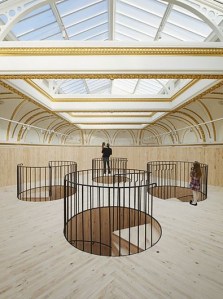
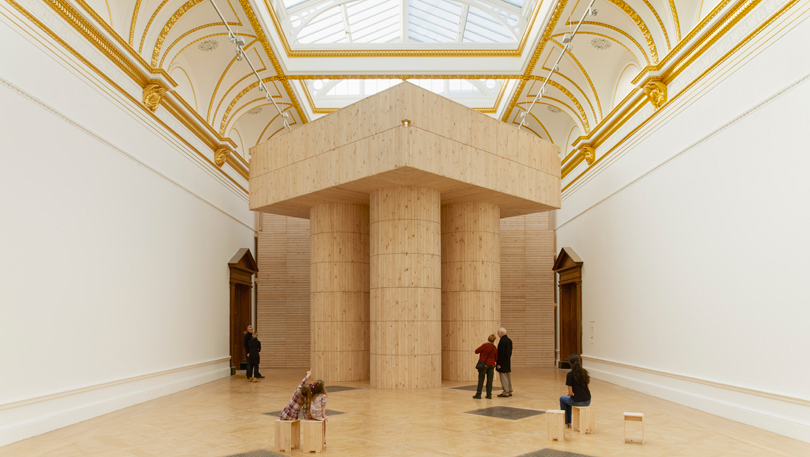
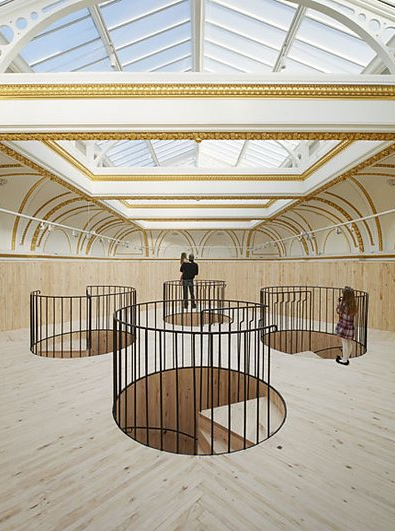
and then you walk into the exhibition, and are immediately struck by this massive wooden installation that fills the one end of the room and almost touches the ceiling. Designed by Pezo von Ellrichshausen it appears solid but you soon realise that people are on the upper level and so you are drawn into it to investigate further. spiral staircases within the columns twist you tightly up to the upper level where you could touch the ceiling. furthermore are tiny little openings at different heights to peer through and see the room again at different angles.
The architects state “Comprising four cylinders and two rectangular forms, this installation is unadorned and apparently primitive in its architectural language. Decoratively mute and on first impression impenetrable, each of the supporting structures provides access to the elevated box above, via four spiral stairwells, one in each of the cylinders, and a ramp that rises inside the vertical box. However, the basic form of construction belies the refinement and precision of its timber structure, which was prefabricated by the architects’ contractors in Chile, before being shipped in modules to London. As an object in itself, the installation also exhibits the architects’ trademark attitude to the art of building, working with a limited palette of materials and the most basic modes of construction to produce an installation that is monumental in relation to the gallery, but intimate and tactile in its engagement with the visitor.
Described by the Chilean architectural duo Mauricio Pezo and Sofia von Ellrichshausen as a small room elevated on four massive columns, this installation extends many of the designers’ enduring preoccupations. “

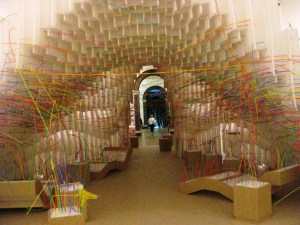
After this we stumbled into the more delicate installation comprising of layers and layers of plastic sheets. This now looks nothing like the promotional photo as there are colourful straws that people have gradually added to the extent that the white is almost unnoticeable. The point is to make you relate to passing through a space, like wind passing through a classroom. The dome gently contracts through the archway between the rooms and you float through this gentle encapsulation slowly.
“Described as a room within a room, this installation by African architect Diébédo Francis Kéré interrupts the Academy’s enfilade of rectangular rooms with a curvaceous wineglass-shaped form that links two galleries and funnels people together into a more intimate cave-like space. Forming an arch made up of a matrix of 60 mm thick honeycomb plastic panels, Kéré’s construction extends his interest in working with ready to hand and adapted material. In this instance, he finds new potential in perforated plastic sheets from Germany, typically used in construction, but hidden within doors and walls as fillers. Kéré’s specification of this material provides a mechanism for interaction and adaptation, with visitors being offered brightly coloured plastic straws to thread through holes in the honeycomb structure and thereby adorn the otherwise monochromatic cocoon with an ever-changing cloak of colour. “


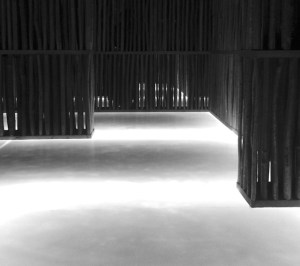
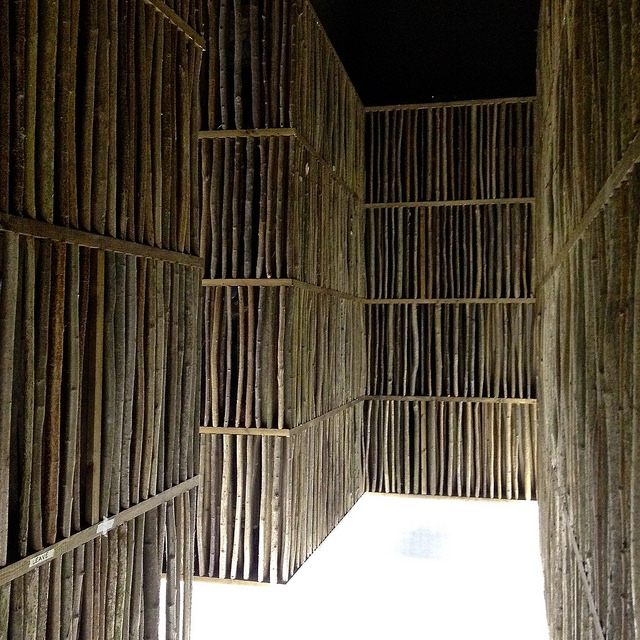
Onwards you eventually come to a maze of sorts, high walls made from layers of twigs, lit from the floor up; a gorgeous smell resonates. within it there are random little wooden modules which are pale and smooth and invite you to sit inside feeling all protected. the maze leads you onto an open area where the floor i made of large scale gravel. At this point I went off it slightly as the one wall was huge mirrors, and this spoiled the otherwise very naturalistic quality of the piece.
The architect Li Xiaodong states “Experienced as a choreographed one-way route, the timber frame is in-filled with small sections of coppiced timber (coppicing is an effective method of growing sustainable timber fast, without the need to replant). An acrylic raised floor is illuminated by LEDs, and plywood-lined niches provide accents along the route, culminating in a space that Li Xiaodong describes as a Zen garden. Complete with pebbles on the floor, this space is presented as the final scene on a route that the architect likens to ‘a walk through a forest in the snow at night’. “

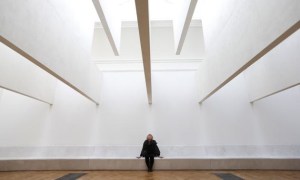
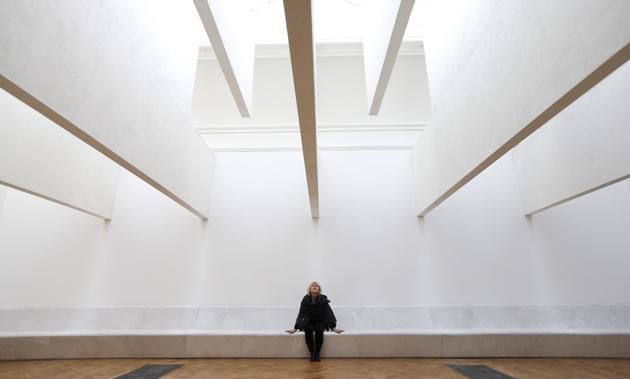
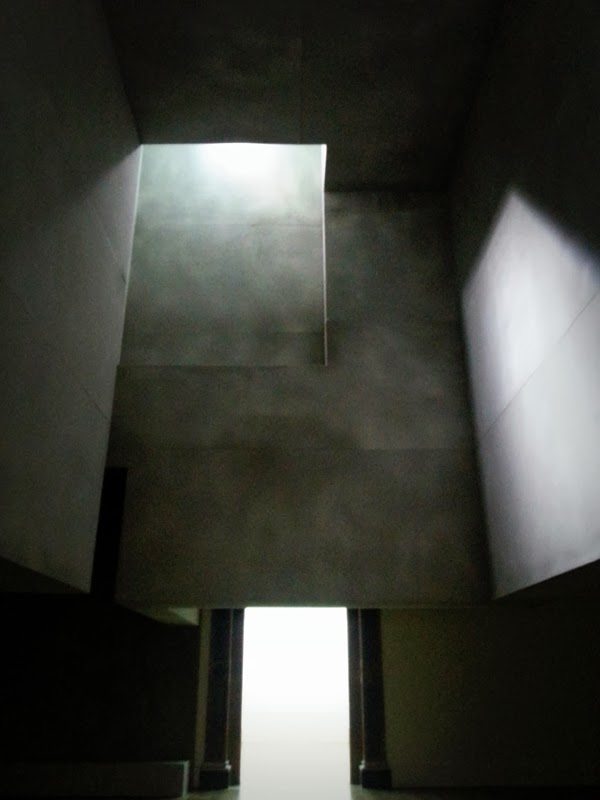
Onto the next room and this is a huge ceiling downwards installation in plain white which looks more like someone is reflecting the walls that should be within the space but this has been done physically by suspending them from above. Not such a successful piece, but the next room was created by the same architects and was incredibly atmospheric. The first half was brightly evenly lit, whereas this was dark, with a light that slowly got ever so slightly brighter but not so much that you could really see into the darkest corners. I sat in one of the corners for quite a while just absorbing the feeling. It was made out of fireboard which is such an ugly material yet they’d made it seem majestic, and how on earth it had been built was beyond me.
“The structures by Grafton Architects, founded by Shelley McNamara and Yvonne Farrell, hover above Gallery IX and the Lecture Room, suspended from the roof lights above. In order to create a strong spatial tension between adjacent rooms and to set up different lighting scenarios, two dramatically different compositions have been made. Choosing only to work with the roof lights, both installations feature a series of suspended surfaces and forms that manipulate the light and reshape the space in two entirely different ways; one as an exploration of lightness, with what is referred to as a waterfall of light, and the other being the exact opposite, exploring weight, containment and the formation of carved-out space.
In the Lecture Room, a series of dark, brooding and apparently massive solid forms obscure most of the existing ceiling and roof light, articulated by two relatively small, high-level ‘apertures’ or openings of light. In contrast to this, Gallery IX features nine blades, suspended in alignment with the gallery’s exposed trusses to reflect a balance of natural and artificial light filtered through the exposed roof light. While both installations drop down within the galleries to create an implied headroom of 2.5 metres within the 8.5-metre-high spaces, two entirely different relationships are established between the floor and the light. In the Lecture Room, the installation intensifies the perception of distance between the floor and the light, while in Gallery IX the hanging blades bring proximity and unity. “
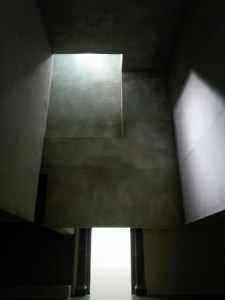
finally, we backtracked and went into a blackened pair of rooms, which for some reason were incredibly cold, no idea if that was relevant, which housed two bamboo structures, incredibly delicate. A clever piece of work, but it didn’t amaze me or absorb me like the other installations had.
“The two installations by Japanese architect Kengo Kuma comprise a pair of delicate structures that occupy the Royal Academy’s Large and Small Weston Rooms. Touching the floor lightly, the structures are made from carefully selected lengths of bamboo, imported especially from Kyoto in Japan. Matured for between three to four years and whittled to a diameter of 4 mm, this material was chosen by the architect to exploit its capacity to be bent into shape. It was also chosen for its ability to absorb and slowly release scent, each piece being impregnated with the liquid scent of Japanese Cyprus or Tatami, before being vacuum-packed and shipped to London. Fragile, yet held in structural balance, each structure is made up from a repeated diamond-shaped module, formed by four lengths of bamboo bound together in pairs by sleeves of heat-shrinkable plastic and pulled apart in opposing directions. Where each module touches the floor, the bamboo is clamped in hidden pockets set within a raised plywood floor, which also provides space for a number of recessed LED light fittings. “


http://www.royalacademy.org.uk/exhibitions/sensingspaces/meet-the-architects/










![[no title] 1971 by Sol LeWitt 1928-2007](https://amosdenton.com/wp-content/uploads/2014/02/sol-lewitt2.jpg)





 amosdenton