Practicalities
OSB Board
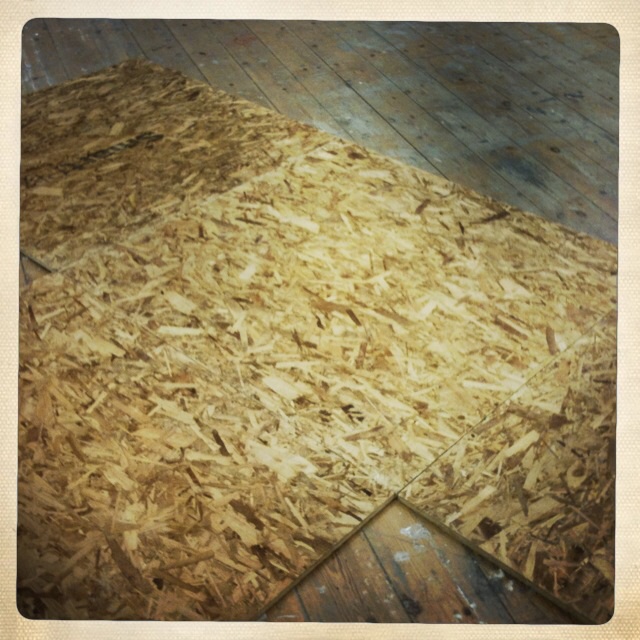
I decided to work with a different wood for a variety of reasons, but the main one being the textural quality of OSB Board. It is quite a common building material nowadays especially in areas that are exposed. I discounted MDF as it has a poor core strength and so probably wouldn’t have stood up to what I was hoping to achieve, plus the surface itself is incredibly bland and would probably repel people rather than draw them in as it is not a tactilely inviting surface. I could have gone with ply but that is been rather over done in recent years, it does have an attractive quality to it, but I still felt it lacked a solidity and could be considered too pretty. Hence the OSB board choice was strong enough but the surface was also enticing and novel enough to draw people in.
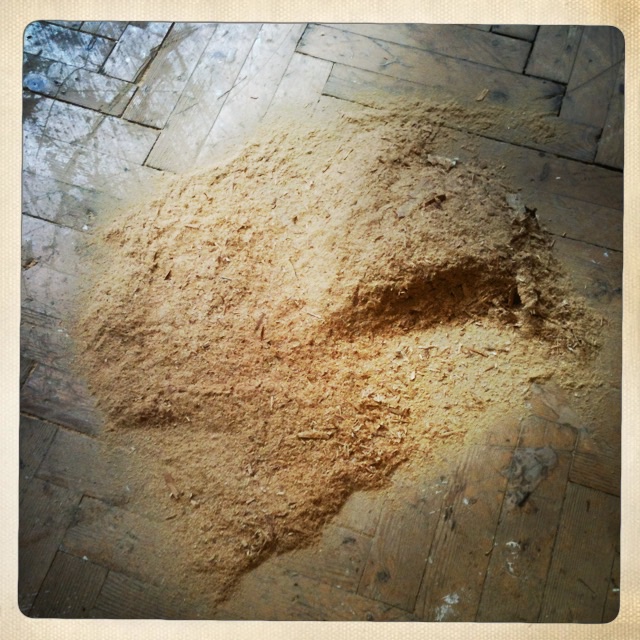
Unfortunately, as all good plans seem to come undone, on the day I had booked the technician for and hour and a half to cut all the pieces he was off sick. Not something that can be helped, but it then resulted in the job at hand taking more than a day as I had to work with the jigsaw (or two as I broke one!) and the band saw to complete it. This has resulted in some cumbersome cuts. However, it had not sat well with me that a technician was doing all the work, as it makes my work seem disconnected from me as an artist, so I guess it became what I wanted in the end. I just wish I’d practiced a bit more with a jigsaw in the last few months!
As it turned out it was quite an unforgiving wood to try to work with. The board is formed of veneered layers randomly assembled, using a mixture of woods. I would periodically hit an incredibly hard section, which would be followed with an area that was like running a hot knife through butter. So the lines that were cut are not perfectly straight, but I accept them as they were made by my hand, not by a flash machine. I found little tricks that made it marginally easier, but still some are not the quality I would have liked initially, but maybe showing that they are made by hand then lends a connection to the public then working with their hands on the cube task, in some sense.
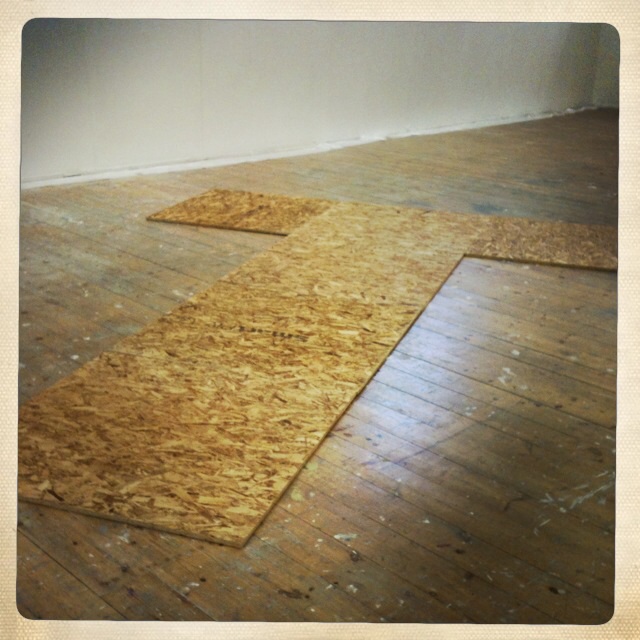
The board works particularly well on the wooden floor, especially the floor that is in B01, which is wider, paler planks than in the top floor studios. The colours are nearer to the OSB board, so it could be seen as something that is coming straight out of the floor, which would be fantastic and add a further element in terms of simplicity and sleekness of design. Equally, the mottled texture is inviting, and the viewers curiosity is added to in terms is making the person have a physical connection to the surface and therefore the structure. If I had painted the wood, I believe this would have removed the tactile nature of the wood. I did consider using reclaimed wood, but to acquire the volume needed, that still had the inherent strength to withstand the task, would have been nigh on impossible.
One of the more challenging elements has been the hinges. While there are over 200 possible hinges available from just one website I needed to ensure the wood laid perfectly flat, so people could walk all over it and not split the wood off the hinge (which would have happened using kitchen cabinet hinges for example). I felt strongly that I did not want the hinges visible from the outside once the cube is folded up, to add to the surprise element of what may be unexpectedly inside. Normal door hinges would have put a slight angle on the wood when laid out, resulting in splitting too, as would a piano hinge. The choice of hinges seems endless but actually there was only one which would lay the board flat, could be fixed on the inside, and would fold the two sheets so that they appear glued together from the outside. That was an essential element; that the cube appears solidly joined from the outside, and reveals no hint that it can be unfolded at first glance. The only hint that it may come apart will be the four pegs in the lid/top. I hope that people will see the pegs and remember all those flat pack pieces of furniture they have built and realise that you should not be able to see them, as they are normally situated between sections helping to hold them together, again igniting their curiosity.
The seat and the desk were obviously relatively simple to build the outer casing, but again I didn’t want any fixings to be exposed if not necessary. From past experience I know that all the fixtures and fittings can greatly detract from the finished product/project but equally cannot be avoided if you wish to assemble something large and safely, so it is best to try to minimise their effect. Equally, previously I have made a feature out of these kind of elements, which can also work well, but due to the functionality of the hinges and bolts needed I could not exaggerate their presence to make them seem more intentionally a feature, and therefore improve their attractiveness.
The journey
After finalising AP1 with a series of cubes, that weren’t received as well as I had hoped for, I realised that I needed to curtail the number of ideas and of cubes utilised within my work. There were particular versions that I felt still had potential to strengthen any further work, and so focused in on these. However, how to further develop them was still unclear.
I reverted back to my idea of using the views that mean something to me to try to give the work some ‘weight’. I had perceived that people would pick up the latex images and hold them against the glass cube to create a view, but no one touched them as ‘you’re not meant to touch the artwork’.
Following on from the group crit, which I found incredibly helpful, where I had shown all the ideas I had to see which were the most well received, I tried to establish a connection with the work that I produce for my business (see sketchbook). However, this seemed to only complicate things further rather than narrow down the ideas.
I began to question where should the cubes be placed, what material could best convey my ideas, but still have a connection with my business. Still nothing was resolved. I then reverted back to the idea I had from my exhibition last year – the life lies. Further lies had begun to pop into my head which connected to what I was doing now and so I felt they should be included too. But this was then a further element to consider rather than eliminating one. Then once again, I felt the need to go back further into work I began initially on my degree. This further confused the situation.
I had clearly taken quite a knock back from the criticisms relayed in the AP1 feedback, and really questioned whether I had at any point had a genuinely decent idea?
So during May I immersed myself in all things work related, and made sure my students put on their best final exhibition possible, and tried to calm myself down to remind me why I began this MA. I do find it a mental struggle to conform to deadlines, and obviously thought my ideas were better received prior to starting this MA. Naturally, I understood that it would be a difficult time, but I had not fully appreciated just how negative I would become about my own work.
I continued to play with the multitude of ideas, whilst also planning my RiP workshops which were to be done with a selection of schools from South and North Birmingham.
I did consider going down into smaller scale and with multiples of each material, but was soon put off that when I saw David Cheeseman’s sculpture. I know no idea is ever truly an original idea, but that was a bit too close in similarity to be safely pursued as an independent idea.
The RiP workshops began to take shape, and the plans were made in fine detail. Each group would come to the ‘Instruction Lab’ and be asked to produce cubes of the same materials and scale as mine, using my instructions, and test to see how effective my instructions were.
At this point I was still playing with adding text to the cubes, and so made some quick paper versions which featured the life lies wrapped around them. I still maintain that these are a good idea, which could be developed further, but after a tutorial, where I was unable to explain the connection to the cubes these have had to be side lined. As too did the idea of using a typewriter, which I couldn’t justify either.
However, by creating these mini paper cubes, I decided to write onto them directly, and found working with them as an entity particularly enjoyable.
I carried on to produce a series of ideas for the interim show, mostly based on a group of cubes, but with variations of size, scale within a group, multiples, location, and accompanying elements (see sketchbook).
Whilst having a debrief tutorial following the RiP workshops, it was realised that actually the element that I was trying to capture was that I wanted other people to make the cube as part of my practice. The idea developed, and returning to the starting point back in September last year, I decided to reconsider the factor of how people feel within a certain size of space. Particularly when they are creating something with their hands.
So how big a cube do you need to be able to create cubes in?
Everything has blossomed from this question. In order to be mathematically correct I am working with ernst and peter neufert architect’s data (see appendix). All calculations have been made according to their guide. The only change that I have controlled is by restricting the height of the cube to be ergonomically matching to the other measurements adhered to e.g. based on what a seated person needs. The designs have been developed to cover other rooms too such as dining, bathroom and kitchen. This was more an exercise to see how far the data could be manipulated to adhere to the now 4ft/120cm scale the ‘office’ cube had realised. There are designs for how these rooms could be constructed to form a home, with a variation of the layout. However, this was just becoming an exercise in moving blocks around to make patterns and did not ignite my interest.
Evaluation
I experience my studio space as a place of inspiration and therefore desire to construct a site for others to be inspired.
The cube to me means
Sanctuary
Clarity
Consistent
Reliable
Familiar
Reassuring
Strong
Tangible
Virtuous
Firm
Solid (arity)
Equal
Mathematical
Linear
Simple
Escape
Reflects its inner core
Elicit
Pure – space in its purest form
A container, a vessel with infinite possibilities for hopes, dreams and aspirations.
I expect the audience to become directly involved in the cube itself, by opening up the lid and stepping inside in order to then make paper cubes from templates. The cube is the form chosen to represent what space we need in order to be creative, but is based on strict guidelines written by architects Ernst and Peter Neufert.
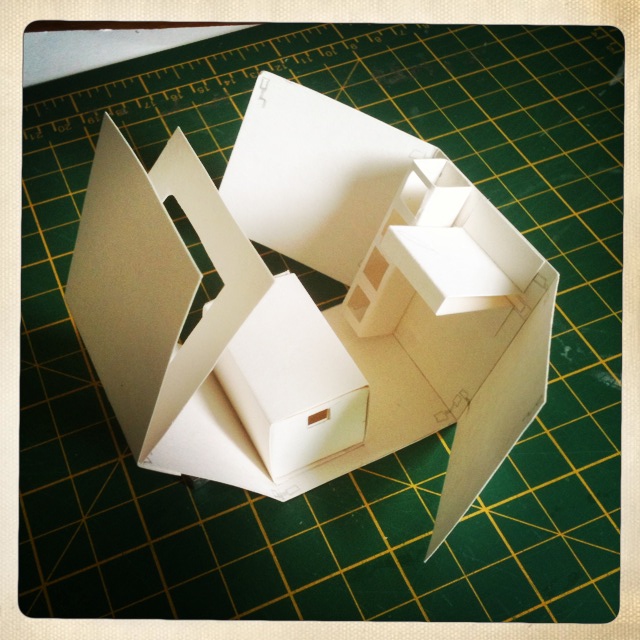
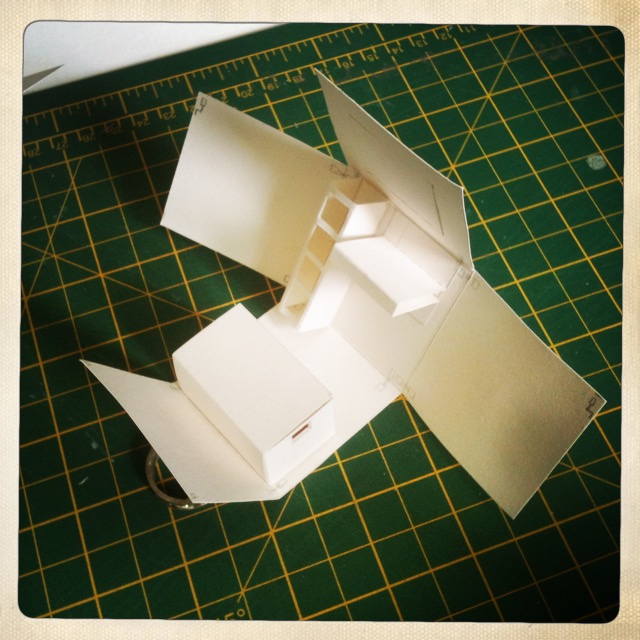
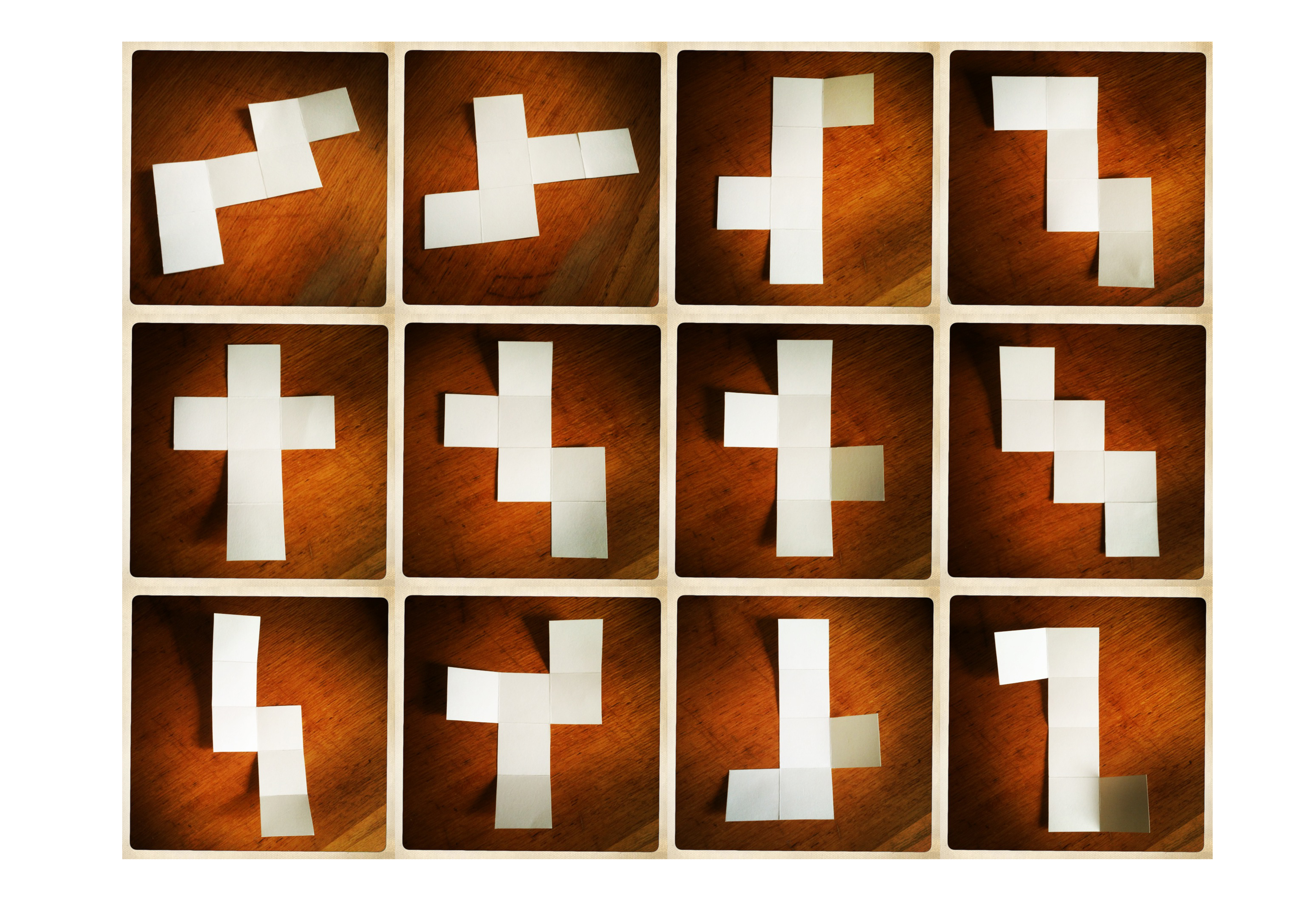
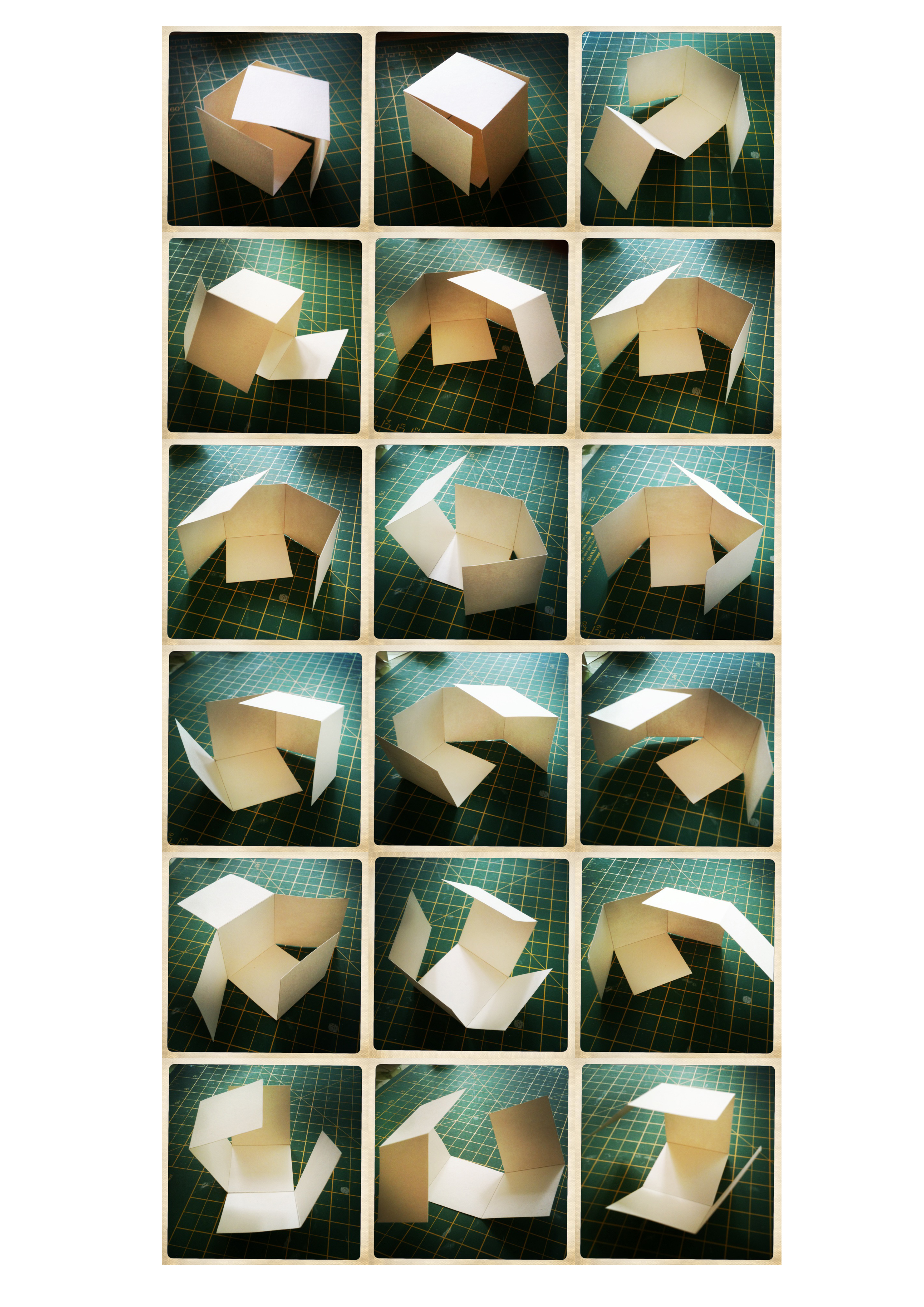
The cube unfolds completely flat to again bring in an element of familiarity in the net of a cube, which the majority should recognise as the base form for a 3D cube.
The wood was chosen for strength, texture and to be a tactile and inviting material to draw the audience in.
The cube is such a universally recognisable form, from quite a young age, although this is not necessarily exclusively designed for younger audience members. However, the scale will imply this, but is actually mathematically correct when based on neuferts’ calculations.
Ideally, the audience will question how much space they really need to work in, feel safe, be familiar and inspired, within the reassuring shape of the cube. I hope they have the impression of how I feel within my studio, and have a brief glimpse into how creating work makes me feel.
Once the cube has been flattened it would be more interesting for me to see what path they take as they walk away from the broken down cube, to see where their journey may take them next. I have considered whether to try to add dust to the surrounding floor once it has been cleaned, or possibly only on the base side which remains flat on the floor at all times. I would then record the footprints in order to move the work on from there.
The overall effect appears to be as I had imagined it, but there are elements, perhaps unreadable in a physical sense, that ideally I would rather have corrected. The emphasis is meant to be about how you feel about a space, but I think the audience will focus in on the scale and construction of the piece. Actually, it is not the wood structure that is important, it is the paper ones that people make. If people step inside the cube and don’t make a cube this is not something that I can necessarily control. Whilst I can drop hints by leaving paper, scissors and glue there is no method to guarantee that this will result in the cubes being made within the cube. Naturally, I don’t want to put people off and feel they can’t experience the cube if they don’t make something, but the more that people experience the space as a creative environment the better. I hope that as they see the paper sheets and the made ones sitting in the shelves that they will feel inspired to do the same. Even if the cubes are not finished, the person sitting in the cube should have the experience of feeling what I feel whilst working in my studio.
I’m not convinced that the cube is really expressing what I am trying to encapsulate. Whilst it is a physically capable space, and my design has been realised to the level I expected to achieve, my concern is that the message will be lost. I’m trying not to focus on the quality as a lack of technical help, plus a limitation of how the technical help was delivered has meant that these elements have been outside of my control. Equally, my own lack of experience with working with OSB board and on this scale of any wood, has directly affected the quality. Naturally, I would rather the quality were better, but I have accepted this is not within my control, and as a result I refuse to nit pick at how this affects the work.
I have endeavoured to design every last element to a precision finish, and have been able to work effectively to working with the figure 4; the cube is 4ft square, the holes in the shelves are 4.8, and the majority of the other measurements are divisible by 4. The paper cubes will be made 4cm square. The four comes from the neuferts calculations and has been a leading force as a result; which has made things easier for me to not have this as a debate internally, in terms of scale. The size of the wooden cube is manageable and not too overpowering to someone initially walking into the room.
The cube at initial glance should appear solid and will not be obviously able to be disassembled unless the person approaches and spots the four pegs in the top. Naturally, once the instructions have been spotted things will quickly become apparent, but ideally they will be just far enough away that people will explore the cube first. There will need to be an inherent confidence in the individual to explore the cube, which I know is going against the grain of what is expected with pieces of art. However, art that is interactive is becoming more commonplace so I am hoping that people will want to be involved. A leap of faith, possibly. I would argue that this is a piece of social art practice, which stems from what happened in my RiP workshops, and is a key element I wish to carry forward.
The cube interacts well with the work of Joanne Henderson, as the lines of perspective within her work give further weight to the three dimensional nature of the cube. The position of the flattened cube forces the audience to stand further back from Jo’s paintings, which I believe to be a better vantage point to view them from. I particularly like the stark contrast between mine and Katie Ecclestons crochet pieces, with the solidity in mine further reinforcing the delicacy and temporary nature of hers. I know that for mine to be destroyed would take an incredible amount of noise and force, polar opposite to the quiet, gentle, gradual process it takes to deconstruct the crochet. I like that there are two further cubes within the room and how my cube is juxtaposed to the plains these create. This helps to lift mine from being another four sided area, into being something with a more enticing quality. I find no connection to the drawings from Frances Hughes, and doubt that our work should be so closely placed in an ideal world. Equally, if the wooden map reference point of Mel Moore’s is too close I think qualities of the pine and my OSB board detract from each other in a negative way. The scale of the room and the position I have settled on strikes me as the only reasonable to one to be fair to others without interfering. However, the main reason for the position is to get the full impact of viewing the cube side on as the viewer enters the room. If everyone were to see the cube as the solid folded version that would be my primary intention, but for the audience to interact with the cube is my main focus and so I accept that at points the first situation the viewer sees could be the cube at any point of construction/deconstruction.
I find the cube as a form now becoming particularly restrictive. I definitely intend to carry forward the social art practice, but will base this on the footprints I record that people will make on the cube and the surrounding floor, hopefully these will be a more fluid line. In essence I wish to capture the journey people take once they have experienced the cube. The floor directly surrounding the flattened cube will be cleaned. The area outside this will have dust added, although this may make little impact as the floors are never cleaned, but still I would like to add dust to try to emphasise the footprints. At least, I hope the footprints left on the base board will be enough to work with. There is an underlying element that I am trying to break free from the cube, and by breaking it down and having people walk away from it, I hope this becomes a physical representation of these feelings.
(And yes, I can see the underlying psychological waves running through that last paragraph)




 amosdenton